
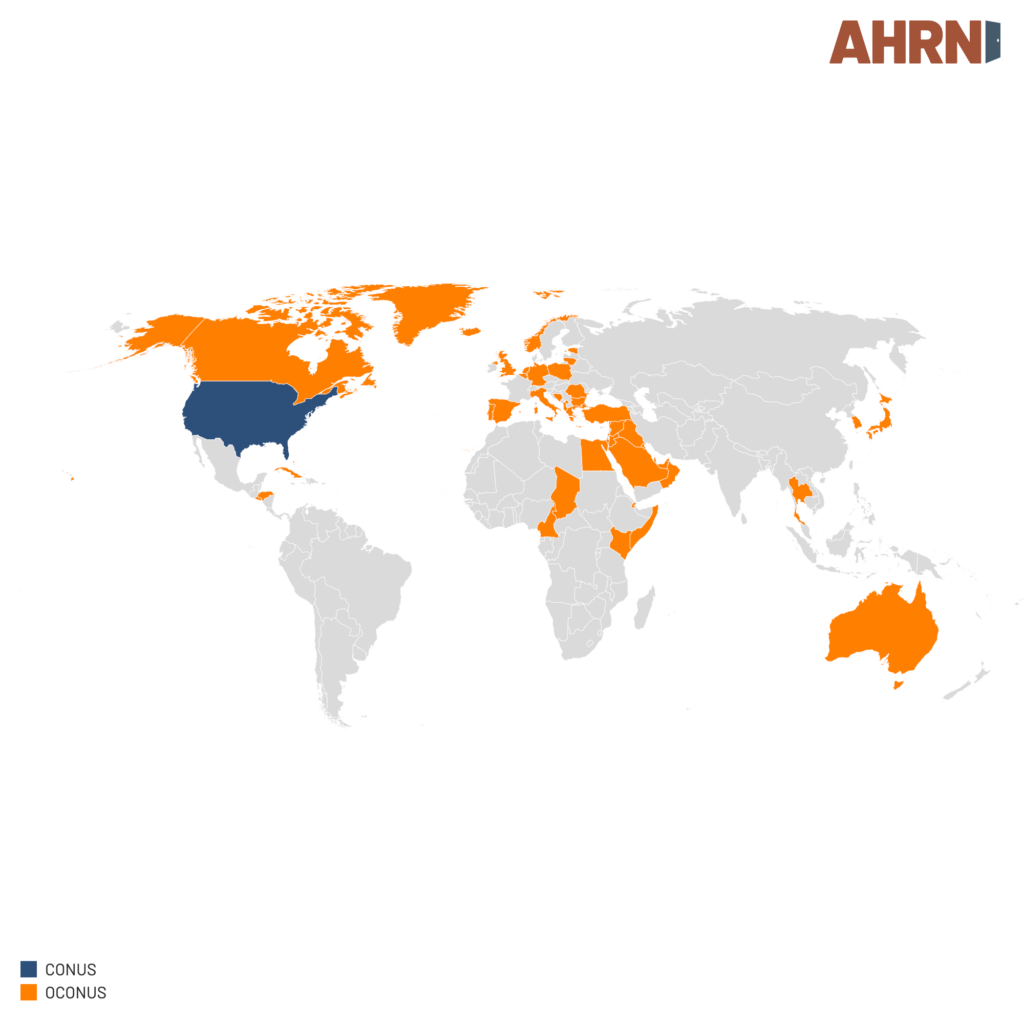
As you prepare for a military move, also known as a Permanent Change of Station or PCS, you’re likely to encounter a lot of regulations and checklists, not to mention a host of new acronyms. Two of the first you’ll see are CONUS and OCONUS, referring to the location of your new duty location.
What “CONUS” and “OCONUS” Mean During a PCS Move
CONUS duty stations are located in the continental U.S., including all 48 contiguous states and the District of Columbia.
The exact method of moving can vary based on how far you have to travel and your household requirements. However, generally speaking, CONUS moves take less time and require fewer official approvals once you have a new set of military orders in hand.
Duty stations outside the continental U.S., or OCONUS, can require extra steps when relocating. OCONUS moves include those to Hawaii, Alaska, Guam, and Puerto Rico (non-foreign OCONUS) as well as to other countries (foreign OCONUS).
Special considerations vary by location and include command sponsorship, pet approval, potential quarantines, and a much more complicated household goods process.
Additionally, foreign OCONUS PCS moves may sometimes involve dependent entry approvals and compliance with status of forces agreement (SOFA) requirements at the specific duty station.
1. Temporary Lodging for PCS Moves: TLE vs. TLA
No matter where you move, chances are you’ll spend some time in temporary lodging, either a hotel or a short-term rental.
These expenses fall outside the typical expected expenses, so the military covers them by authorizing Temporary Lodging Expense (TLE) or Temporary Lodging Allowance (TLA). You’ll receive one of these two allowances depending on your new duty station:
- TLE applies in CONUS and certain non-foreign OCONUS (e.g., Alaska, Hawaii, U.S. territories) for PCS travel within the U.S.
- TLA applies in foreign OCONUS (and some designated non-foreign OCONUS situations) to help offset costs while seeking permanent housing.
How Military Families Get Paid for Hotels During PCS
During a PCS move, lodging costs are typically covered through one of the following programs:
CONUS and certain non-foreign OCONUS
Temporary Lodging Expense (TLE) covers up to 14 days during CONUS moves, extendable to 30 days in areas with recognized housing shortages. TLE offsets lodging and meal costs up to a percentage of local per diem rates. Lodging requires receipts; meals are reimbursed at a flat rate.
Foreign OCONUS (and some designated non-foreign OCONUS)
Temporary Lodging Allowance (TLA) is authorized for 60–120 days, depending on location (90–120 days common in Europe and high-cost markets). You can receive up to 10 days of Departure TLA when leaving your OCONUS duty station.
TLA amounts are based on local per diem rates. Submit paperwork every 15 days, including lodging receipts and proof you’re actively seeking housing.
2. Privately Owned Vehicles (POVs) Shipment Rules
Relocating to your new duty station with your car is likely necessary to get to and from work, not to mention to take advantage of everything your new home has to offer. But how do you transport your privately owned vehicle (POV) when preparing for a military move?
CONUS POV Shipping
With CONUS moves, you have more options to get your vehicle to your new city. You can ship your car from one place to another using a third-party shipping company. You can also drive your vehicle or tow it behind a moving truck.
For CONUS moves, the government neither pays for nor authorizes specific vehicle relocations. Still, they will pay Monetary Allowance in Lieu of Transportation (MALT) for up to two privately owned conveyances (POC), another acronym for a personal vehicle.
MALT is based on a per-mile rate and calculated using the distance between the two duty stations.
OCONUS POV Shipping
Moving your vehicle to your new OCONUS duty station requires extra prep work but less out-of-pocket expense. The government may authorize shipment from the continental U.S. to your new OCONUS duty station but for just one vehicle per service member.
However, this could be subject to host-nation and command restrictions. Some duty stations in Korea and Japan, for example, restrict POV shipments. Speak with your gaining command and the travel office for specifics about your new duty station before shipping your POV.
POV SHIPPING TIPS
- Have a bill of sale if purchased within 90 days prior to the ship date.
- Clear all recalls.
- Remove belongings.
- Have less than 1/4th tank of gas in the car before shipping.
3. Household Goods (HHG) Weight & Storage Rules
Military moves are based on the weight of your household goods (HHG), not the number of rooms or the size of your home.
The exact weight authorized depends on your rank at the writing of your official orders and the number of dependents claimed in your military record. Higher-ranking military members, as well as those with more dependents, are authorized to move more HHG, though the maximum weight allowed is 18,000 pounds.
When conducting an HHG move, you can ship them using a military-approved carrier paid directly through the Transportation Office or arrange the move yourself and submit for reimbursement. For OCONUS moves, it’s best to work directly with your new command or installation, as additional requirements and paperwork may apply.
You can temporarily store your HHG, which may be necessary if you are awaiting housing or completing a renovation before moving in.
Current Joint Travel Regulations allow up to 90 days of storage in transit (SIT) for both CONUS and OCONUS, with possible extensions up to 180 days or more when justified (e.g., deployment, housing unavailability).
4. Cost of Living Allowances
The actual cost of living, which refers to the difference in typical daily expenses like food and gas, can vary widely even among cities in the U.S. Housing is not considered a cost of living since it falls under its own allowance category.
When considering OCONUS duty stations with a different local currency, your military paycheck can be affected. However, the government considers this too and authorizes a cost-of-living allowance (COLA) to offset the differences.
CONUS COLA
CONUS COLA is only authorized in areas at 107% of the national average. The government uses the duty station zip code, your rank, years of service, and number of dependents to calculate COLA. Data is analyzed annually to see if COLA rates need adjustment.
OCONUS COLA
OCONUS COLA is provided more often and accounts for the exchange rate if needed. The exact rate is based on your location, rank, time in service, and number of dependents.
One important distinction is that COLA received at a CONUS duty station is taxable, just like income. However, COLA provided at an OCONUS duty station is not taxed.
5. Housing Allowances BAH vs. OHA
Housing is one of the biggest expenses a military member must account for when moving. The cost to buy or rent a home varies by location, which is why your duty station’s zip code is the primary metric used to determine CONUS housing allowances.
CONUS BAH
At a CONUS duty station, you receive Basic Housing Allowance (BAH), determined using your duty station’s zip code as well as your rank and number of dependents.
The average cost of rentals determines non-taxed BAH rates, but you can use this allowance to cover rent or mortgage payments. Those living in military-provided housing generally do not receive BAH. In some cases, you can receive partial BAH or BAH-Diff to cover child support.
OCONUS OHA
For OCONUS moves, housing expenses are included in an Overseas Housing Allowance (OHA).
OHA is designed to cover rent and certain utility costs overseas, but unlike BAH, OHA is based on your actual rent up to a cap, not a flat rate you always receive.
A move-in housing allowance (MIHA) covers move-in expenses. It provides a lump sum to pay for items required to rent in the local economy at their OCONUS duty station, such as a security deposit.
Final Thoughts
Getting ready for a military move can be both exciting and overwhelming. Taking on the challenges of a new job along with establishing a new home can be easier by knowing what entitlements and allowances to expect during the move.
From lodging during the move to transporting your vehicle, the differences between a CONUS and OCONUS move can be quite significant.
Cost-of-living allowances and housing expenses are primarily based on your CONUS or OCONUS location and help ensure you can afford to live comfortably in your new city.
Download AHRN's PCS Toolkit

Written by Katie Melynn
Katie Melynn is a Navy Veteran and writer with experience navigating PCS moves, including DITY moves and pandemic-era relocations. She has been writing professionally for over eight years, with work featured in Monterey Bay Parent, SHORE Monthly, PEOPLE, The Spruce, and more. Katie currently serves as the community content liaison for At Ease Monthly, a lifestyle magazine for the military and Veteran community. When she’s not writing, Katie teaches Creative Writing through an arts magnet program in Anne Arundel County and stays busy keeping up with her three kids. Follow Katie at @katiemelynnwriter.

Reviewed by Jason Van Steenwyk
Jason Van Steenwyk is a U.S. Army veteran and longtime writer covering military life, housing, mortgages, real estate, and personal finance. He's an Iraq war veteran and former infantry soldier and now writes to help fellow service members, veterans, and their families make smart financial and housing decisions. Over the past two decades, his work has appeared in dozens of publications dedicated to supporting military families and veterans.